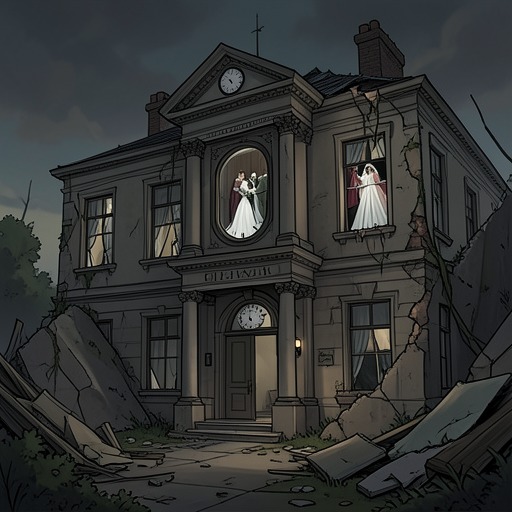
Satis House’s arrested decay
Great ExpectationsSatis House’s arrested decay turns a once-prosperous estate into an inhabited ruin, making abandonment tangible in its barred entrances, idle brewery, stopped clocks, and disintegrating bridal relics. The house does not merely shelter Miss Havisham’s grief: its rooms and objects preserve that grief as an environment, and their repeated appearances teach Pip to experience the place as both a physical landscape and a pressure exerted by memory.
A Closed and Disused Estate
When Pip first arrives with Mr. Pumblechook, the old-brick house seems designed to exclude the living. Iron bars cover its lower windows and front courtyard, some windows have been walled up, and the great entrance is chained. Alongside it stands a brewery that has not operated for a long time. The contrast between a substantial estate and its shut, empty buildings establishes decay not as sudden ruin but as prolonged suspension.
Inside the grounds, neglect has begun to overtake their formal order. The courtyard is paved and clean, yet grass grows in every crevice; the brewery lane and buildings stand open and empty, while wind howls through the abandoned structure. Miss Havisham’s young guide says brewing is finished and the place will remain idle until it falls. The cellars still contain enough strong beer to drown the Manor House, a remnant of former production that survives without any continuing use for it.
The brewery’s emptiness is registered through a catalogue of absences. A pigeon-house leans crooked in the wind, but has no pigeons; the stable, sty, and storehouse hold no animals or malt. The copper and vat have lost even the smell of grain and beer. Empty casks preserve a sour trace of better days, while the neglected garden beyond has tangled weeds and paths worn by someone’s occasional passage. These details make decay legible through the disappearance of work, animals, smells, and ordinary activity.
Stopped Time and Preserved Objects
The house’s abandonment becomes most concentrated in its clocks. In Miss Havisham’s room, both her watch and the room’s clock have stopped at twenty minutes to nine. Later, Pip sees the same time fixed on the clock in the wall of the detached dwelling across the courtyard. The repeated hour makes suspended time part of the estate’s larger architecture rather than an isolated peculiarity of one room.
The objects surrounding Miss Havisham reinforce that arrested condition. A jewel is returned to precisely the place from which she lifted it; a once-white shoe has yellowed without ever being worn, while the silk stocking on the foot without it has yellowed and been trodden ragged. Her faded bridal dress and long veil appear like grave-clothes and a shroud. The contrast between the unworn shoe and the damaged stocking gives the room’s stillness a bodily and unsettling quality: objects have aged, but the life their arrangement implies has not resumed.
The feast chamber extends this tableau into a larger field of decay. Daylight is excluded; an old fire struggles in a damp grate, and reluctant smoke hangs in the room. Dust, mould, and disintegration cover a space that had once been handsome. A long table remains laid as though a feast had been interrupted when the house and its clocks stopped together. The obscured centrepiece, thick with cobwebs, has become a hub for spiders, while mice rattle behind the panels and beetles wander across the hearth. The room’s carefully preserved signs of preparation have been overtaken by the slow, indifferent activity of other inhabitants.
The Ruin as a Scene of Memory
Satis House’s decay repeatedly draws Pip into its neglected spaces. During an early visit, he watches Estella cross the garden and brewery, appearing among extinguished fires, climbing an iron stair, and vanishing along a high gallery. The empty industrial setting becomes entangled with his attention to her: its abandoned routes and shadows stage her movement while making the estate seem at once vast and inaccessible.
On a later return, the neglected garden again frames the encounter. A small remnant of overnight snow clings to a cold, shaded corner beneath a misshapen box tree; wind lifts it into eddies and casts it against the window where Pip stands. The detail gives the ruined grounds an immediate physical presence while preserving their isolation. Elsewhere in the estate, passageways lead through the dark basement to a courtyard and a former brewery manager’s dwelling, linking the house’s interior gloom to the disused works beyond it.
When Pip returns as an adult, the garden is still neglected, and Miss Havisham sends him and Estella out to walk there. He passes through the gate connected with his first meeting with the pale young gentleman, now Herbert. The place binds different periods of Pip’s life together: its repeated paths and ruins make his present visit inseparable from the childhood encounters he remembers there.
Change, Repetition, and Narrative Meaning
The estate’s condition is not a simple picture of a past that has vanished. Its buildings remain standing, its cellars hold beer, and its rooms retain the forms of a feast and wedding, yet their original uses have ended. That tension between material persistence and practical abandonment gives Satis House its distinctive arrested quality: the past remains visible, but it survives as residue rather than renewed life.
The house also makes memory spatial. Dark passages, shut entrances, abandoned brewery buildings, and rooms dense with decayed objects organize Pip’s experience into repeated returns. Each visit brings him through familiar architecture toward new encounters, while old details—the stopped clocks, bridal relics, and neglected garden—keep the earlier visit present. The setting’s recurrence allows the story to set remembered feeling against later knowledge without making the place itself appear restored.
Satis House’s arrested decay therefore links physical neglect to emotional and narrative suspension. Its halted clocks, abandoned production, and preserved wedding scene turn time into something that can be seen in rooms and things, while the estate’s repeated appearance traces how Pip’s past continues to shape his perception. Yet the grounds are not literally frozen: snow melts, weeds spread, insects move, and the buildings deteriorate. That slow change, set against the house’s preserved arrangements, makes the ruin both a monument to a fixed wound and a living environment still undergoing decay.